
6 Best Price Tracking Strategies 2026 for Online Shoppers
You spot a deal online, but minutes later the price changes or the item sells out. Competing offers pop up across dozens of retailers, each with slightly different pricing. Shopping smart becomes confusing and time-consuming, leaving you uncertain about when to buy and whether you got the best deal.
The good news? There are practical strategies you can use to track prices, predict discount patterns using real data, and make sure you never overpay. With the right tools and a bit of know-how, you can catch price drops the moment they happen—without wasting time on guesswork or endless comparisons.
Get ready to discover actionable insights that turn you into a truly informed shopper. These proven methods will show you how to automate alerts, read price trends, and confidently time your purchases for real savings.
Table of Contents
- Set Up Automated Price Alerts For Favorite Items
- Use Price History Charts To Predict Discount Trends
- Track Multiple Retailers For Instant Price Comparisons
- Leverage Timing Tools For Holiday And Flash Sales
- Create Custom Watchlists To Manage Desired Products
- Avoid Common Pitfalls And Maximize Your Savings
Quick Summary
| Takeaway | Explanation |
|---|---|
| 1. Set Up Automated Price Alerts | Automate price tracking to receive notifications about deals without manual checking. |
| 2. Utilize Price History Charts | Analyze past prices to anticipate future discounts and inform buying strategies. |
| 3. Compare Prices Across Retailers | Track multiple sellers to ensure you buy at the absolute lowest price available. |
| 4. Leverage Timing Tools for Sales | Know when major sales happen and be prepared to act quickly for best deals. |
| 5. Create Custom Watchlists | Organize desired products to manage alerts and simplify decision-making. |
1. Set Up Automated Price Alerts for Favorite Items
Automated price alerts are your personal shopping assistant working 24/7 without you lifting a finger. Once you set them up, they monitor prices and notify you the moment your target price drops.
Here’s why this matters: You identify items you want, set your ideal price point, and the system does the watching. You get the notification. You decide whether to buy. This removes the guesswork and the stress of constantly checking prices manually.
Why Automated Alerts Beat Manual Checking
Manually checking prices requires discipline. You have to remember to look. You have to visit multiple sites. You have to compare. Most people don’t do this consistently, which means they miss deals happening in real time.
Automated alerts eliminate this friction entirely. The tracking happens whether you’re sleeping, working, or busy with life. When a price drops to your target, you get notified immediately.
Automated price alerts transform passive shopping into active savings—you set it once and save repeatedly without lifting a finger.
How to Set Up Your First Alert
The process is straightforward and takes just a few minutes. Setting up alerts through your preferred platform typically involves these steps:
- Add the product you want to track
- Set your target price (the price at which you’d actually buy)
- Choose your notification frequency (real-time, daily digest, weekly summary)
- Confirm your contact preference (email is standard)
- Hit save and forget about it
Some platforms let you customize notification settings based on your preference. You can receive alerts immediately or batch them into daily or weekly digests to avoid notification overload.
Make Your Alerts Work for You
There’s a strategy to getting the most value from alerts. Don’t set your target price too low, or you’ll wait forever and miss legitimate buying opportunities. Look at the automated search alert setup process, which shows how to specify frequency and content formats to optimize tracking over time.
Set realistic target prices based on historical data. If an item normally sells for $50 and drops to $45 during sales, that’s your alert threshold. This keeps your alerts relevant and actionable.
- Track seasonal items before their peak seasons
- Set alerts for multiple price points if you want flexibility
- Review and adjust alerts quarterly as prices change
Pro tip: Set up alerts for items before you actually need them—this gives you weeks or months of price history to work with, and you’ll catch the best deals without pressure to buy immediately.
2. Use Price History Charts to Predict Discount Trends
Price history charts are visual maps of how an item’s cost has moved over time. They show you patterns that reveal when discounts typically happen and help you predict when the next price drop might occur.
Think of it this way: patterns repeat. If an item drops to its lowest price every December, you can plan accordingly. If it spikes in price before seasonal sales, you know to wait. Charts make these patterns visible.
Reading the Visual Story
A price history chart displays price on the vertical axis and time on the horizontal axis. Each point represents what the item cost on that date. Lines connecting the points reveal trends over weeks, months, or even years.
When you see a line dip sharply downward, that’s a discount event. When it climbs upward, demand is high or discounts have ended. Over time, these movements form patterns that repeat.
Price history charts transform raw numbers into visual patterns you can actually understand and use to make smarter buying decisions.
Why Patterns Matter for Your Wallet
Consumer goods follow predictable pricing patterns. Price index trends show that seasonal items experience consistent discount cycles based on demand and retailer strategies. Electronics typically drop in price after new models release. Clothing goes on sale at season changes. Holiday items discount after the holiday passes.
Once you recognize these patterns, you stop buying randomly and start buying strategically. You know when to strike and when to wait.
How to Use Charts Effectively
Look for these key patterns when studying price history:
- Regular dips at the same time each year (seasonal discounts)
- Price spikes before major retail events (data shows pre-sale increases)
- Gradual declines as products age (older models get cheaper)
- Sudden drops indicating clearance sales
Spot a pattern that repeats annually? Mark your calendar. Plan to buy when that cycle comes around again.
Real Data Tells the Story
The Bureau of Labor Statistics publishes extensive historical price data showing average prices over time, making it easy to observe past discount patterns and forecast future price reductions. This data proves that prices don’t move randomly—they follow measurable trends.
When you combine individual product charts with broader market trends, you develop intuition about when to buy almost anything.
Pro tip: Screenshot or bookmark price charts for items you track regularly, then compare them every few months to spot emerging patterns before they become obvious to other shoppers.
3. Track Multiple Retailers for Instant Price Comparisons
The same product sells for different prices across different retailers. Amazon might charge $89.99 while Walmart has it for $79.50. Best Buy could be at $84.99. Without checking all three, you would overpay by up to $10 without realizing it.
Tracking multiple retailers simultaneously reveals these price gaps instantly and lets you always buy at the lowest price available.
Why Price Differences Exist Across Retailers
Retailers don’t price items identically. They compete differently based on their business model, overhead costs, and target audience. Some retailers offer premium service and charge accordingly. Others focus on volume and offer lower prices.
Price dispersion among online retailers shows that consumers benefit from tracking prices across multiple sellers to find the best deals, since differences in service levels and retailer recognition drive pricing variability.
This isn’t a flaw in the market. It’s an opportunity for smart shoppers who pay attention.
When you track multiple retailers, you stop paying whatever price one site charges and start paying the actual market rate.
The Instant Comparison Advantage
Manual comparison shopping takes forever. You visit Amazon, check the price, navigate to Walmart, note their price, then check Best Buy. By the time you finish, a sale might have ended or prices might have changed.
Automatic multi-retailer tracking eliminates this time sink. The system watches prices across ten, twenty, or even more retailers simultaneously. You see the lowest price available right now.
How to Leverage This Strategy
When you track items across multiple retailers, you gain access to the widest selection of pricing data. Retail pricing trends show that monitoring diverse retailers’ pricing helps you identify discounts and leverage market pricing variability for better purchasing decisions.
Set up tracking for major retailers in your favorite categories:
- Amazon (largest selection, often competitive pricing)
- Walmart (strong grocery and electronics prices)
- Target (competitive apparel and home goods)
- Best Buy (electronics and tech)
- eBay (sometimes has independent sellers with lower prices)
- Specialty retailers specific to your interests
The more retailers you track, the better your odds of finding the absolute lowest price.
Real Savings Examples
Consider a laptop typically priced around $599. Track it across four retailers and you might find a range from $549 to $599. That $50 difference pays for months of streaming services. Over a year of shopping, these differences compound significantly.
Electronics, clothing, and kitchen appliances show the widest price variation. Everyday items vary less but still offer savings opportunities.
Pro tip: Focus your multi-retailer tracking on products with wider price ranges (electronics, furniture, appliances) where 5 to 15 percent price differences are common, rather than items with standardized pricing.
4. Leverage Timing Tools for Holiday and Flash Sales
Flash sales last hours. Holiday sales peak on specific dates. Knowing exactly when these events happen means the difference between catching massive discounts and missing them entirely. Timing tools remove the guesswork by alerting you to upcoming sales events.
Think of timing tools as your personal shopping calendar. They track historical patterns and notify you when sales are likely to happen, so you’re ready to buy when prices drop.
Why Timing Matters During Sales Events
Retailers aren’t secretive about when they hold sales. Black Friday happens in November. Cyber Monday follows Thanksgiving. Prime Day occurs in July. These patterns repeat year after year, and prices predictably drop during these windows.
But here’s what most shoppers miss: prices within those events fluctuate. The best deals on day one might be gone by day three. Products sell out. Inventory limitations force price adjustments. Timing your purchase within the sale event itself matters tremendously.
Timing tools transform you from someone who shops during sales into someone who buys at the exact moment prices are lowest.
How Timing Tools Work
These tools analyze historical retail trade data showing seasonal and holiday sales patterns to predict when major sales events will occur and help you time purchases strategically around these identified periods.
Timing tools track several types of data to forecast sales:
- Historical sales calendars from previous years
- Retailer announcements about upcoming events
- Real-time price movement indicators
- Inventory level changes
- Competitor activity patterns
When these signals align, the tool alerts you that a sale is likely happening or about to happen.
Leveraging This for Maximum Savings
You need a two-part strategy. First, identify major sale events in your calendar months in advance. Second, use timing tools to catch the best prices within those events.
Consumer behavior during price promotions shows that timing purchases strategically around seasonal discounts and flash sales optimizes savings by aligning your buying with periods when price elasticity is highest.
Major sale events to track:
- Black Friday and Cyber Monday (November)
- Prime Day (July)
- Back to School (August and September)
- Holiday Gift Giving (November and December)
- Boxing Day (December 26)
- New Year Sales (January)
- Spring Sales (March and April)
Set alerts for items you need before these dates arrive. When the sale begins, your price tracking tool will notify you of drops within the first few hours, giving you the advantage.
Pro tip: Track items you want two to three months before major sales so you see price patterns leading up to the event, allowing you to recognize the absolute lowest price when it appears rather than settling for a decent discount.
5. Create Custom Watchlists to Manage Desired Products
Wishlist chaos is real. You want a laptop, three pairs of shoes, a coffee maker, and a gaming monitor. Without organization, tracking these items becomes overwhelming. Custom watchlists organize your desired products into categories so you can manage dozens of items without confusion.
Think of watchlists as your personal shopping inventory. Each list groups related items, making it easy to see which products are dropping in price and which ones need your attention.
Why Organization Matters for Savings
When you track products haphazardly, you miss price drops. Notifications pile up. You lose track of which items you’re actually interested in buying soon versus ones you’re just curious about. Organization creates clarity.
Custom watchlists solve this by letting you segment products into categories like “Need Soon,” “Nice to Have,” and “Future Consideration.” This separation helps you prioritize which alerts matter most.
Custom watchlists transform scattered product interests into organized, actionable shopping lists you can actually manage.
Setting Up Your Watchlist System
The process of managing and tracking desired products through custom watchlists involves creating lists, adding specific items, and receiving notifications about price changes and availability.
Start by identifying major product categories that match your shopping habits:
- Electronics and tech gadgets
- Clothing and footwear
- Home and kitchen items
- Books and media
- Sports and fitness equipment
- Travel and accessories
Create a watchlist for each category. Add items you’re genuinely interested in buying within the next 6 to 12 months. This prevents list bloat while keeping your attention on realistic purchases.
Organizing for Maximum Impact
Within each watchlist, organize items by priority or purchase timeline. Move items closer to purchase date to the top. Archive items you’re no longer interested in. This active management keeps your watchlists relevant.
Many successful price trackers organize watchlists by purchase urgency:
- Immediate (buying within one month)
- Soon (buying within three months)
- Later (buying within six to twelve months)
- Someday (long-term aspirational items)
This structure helps you focus your attention where it matters most. You prioritize alerts for immediate purchases while monitoring others more passively.
Real-World Watchlist Management
Suppose you need a new laptop within two months and a monitor within four months. Put the laptop in your “Immediate” list and the monitor in “Soon.” When prices drop on either item, you see the alert in context. You know a laptop price drop requires quick action, while a monitor drop can wait.
Watchlists prevent you from acting on mediocre deals while missing excellent ones. You develop a visual sense of what constitutes a real bargain for each item.
Pro tip: Create a watchlist specifically for “Price Watching” items where you track products just to observe their patterns before you’re actually ready to buy, giving you months of data to recognize true bottom prices.
6. Avoid Common Pitfalls and Maximize Your Savings
Price tracking is powerful, but mistakes can cost you money. Some pitfalls are obvious. Others hide in plain sight. Knowing what to avoid transforms you from someone who tracks prices into someone who actually saves money consistently.
The difference between tracking prices and saving money comes down to avoiding these critical mistakes.
Pitfall One: Trusting Sponsored Results
Search platforms aren’t neutral. They prioritize results that make them money, not results that benefit you. When you see a “sponsored” price listing, that item appears first because the retailer paid for placement, not because it’s the best deal.
Search platforms can rewrite results to maximize profits, potentially misleading consumers about actual prices. Always check whether a price result is sponsored before assuming it’s the lowest available.
Verify prices across multiple independent sources rather than relying on a single platform’s recommendations.
The cheapest price on a sponsored ad is rarely the actual lowest price available in the market.
Pitfall Two: Ignoring Seller Reputation
A low price means nothing if the seller is untrustworthy. Counterfeit products, scams, and non-delivery happen constantly. Before celebrating a price drop, verify the seller’s legitimacy.
Being vigilant about sellers’ reputations and checking multiple trustworthy review sources helps you avoid scams while understanding product conditions like refurbished items. Read recent reviews from verified buyers. Check seller ratings across multiple platforms.
Avoid sellers with consistently negative feedback, vague product descriptions, or deals that seem too good to be true.
Pitfall Three: Missing Hidden Costs
A product advertised at $49.99 might arrive with $15 in shipping fees and a $5 restocking charge if you need to return it. The real cost is $69.99, not $49.99.
Always factor in:
- Shipping costs and delivery speed
- Return shipping costs and policies
- Taxes and applicable fees
- Warranty and extended protection plans
- Refund or restocking fees
The lowest advertised price often isn’t the lowest total cost. Calculate the complete expense before deciding a price is good.
Pitfall Four: Impulse Buying on “Deals”
Price trackers work best when you track items you genuinely want and need. Tracking hundreds of random products creates decision fatigue and tempts impulsive purchases. You see a 40 percent discount and buy something you didn’t actually need.
Stick to tracking items you’d buy regardless of price. Only the timing changes based on mastering the price tracking process for smart savings, not the decision itself.
Pitfall Five: Not Acting Quickly Enough
Flash sales end fast. Limited inventory sells out. Good prices disappear within hours. Hesitation costs money. When your price alert fires and the price hits your target, move quickly or risk missing the deal.
Set up payment information in advance so you can complete purchases in minutes, not hours.
Pro tip: Before tracking any product, ask yourself if you’d buy it at full price, then only purchase when your tracked price target is reached to avoid buying things you don’t actually need.
Below is a comprehensive table summarizing the key strategies and insights for optimizing online shopping through price tracking, as discussed in the article.
| Strategy/Concept | Description | Key Points/Benefits |
|---|---|---|
| Automated Price Alerts | Use technology to monitor price changes for items of interest, notifying when prices drop to set target levels. | Saves time, avoids manual checking, ensures timely notifications for price drops, and helps secure the best deal. |
| Utilizing Price History Charts | Analyze past pricing trends to predict future price fluctuations and optimal buying times. | Identify discount patterns, plan purchases during regular sales, and gain insights into market behaviors to maximize savings. |
| Multi-Retailer Price Tracking | Compare item prices among multiple retailers to secure the lowest price available. | Avoid overpaying by considering diverse pricing from various retailers; increases opportunities for significant savings. |
| Timing Tools for Sales Events | Leverage tools that forecast sales periods and allow precise planning to shop during the best deals in holiday and flash sales. | Optimize purchase timing to benefit from short-term and seasonal sales; avoid missing out on time-sensitive discounts. |
| Custom Watchlists | Create and manage categorized lists to follow desired products and streamline notifications about price updates and availability. | Maintain organization, prioritize alerts, and actively manage interest levels for efficient and planned shopping. |
| Avoiding Mistakes | Be aware of common pitfalls such as impulse purchases, sponsored results, unreliable sellers, and hidden costs to make truly informed purchasing decisions. | Minimize unnecessary expenses, purchase with confidence, and improve overall effectiveness of each transaction. |
Take Control of Your Shopping with Smart Price Tracking
Managing multiple online retailers and timing your purchases perfectly can feel overwhelming but it does not have to be that way. The article highlighted key challenges like missing flash sales, juggling alerts, and recognizing real discounts versus sponsored listings. These common pain points make it hard to save money without constant manual effort and stress.
PriceLix solves these problems with powerful automation. Our platform lets you set automated price alerts across hundreds of stores including Amazon, eBay, and Walmart, so you never miss that perfect price drop. You can organize your items into custom watchlists to easily prioritize purchases and avoid impulsive buys. Plus, detailed price history charts help you understand discount patterns to confidently time your buys.
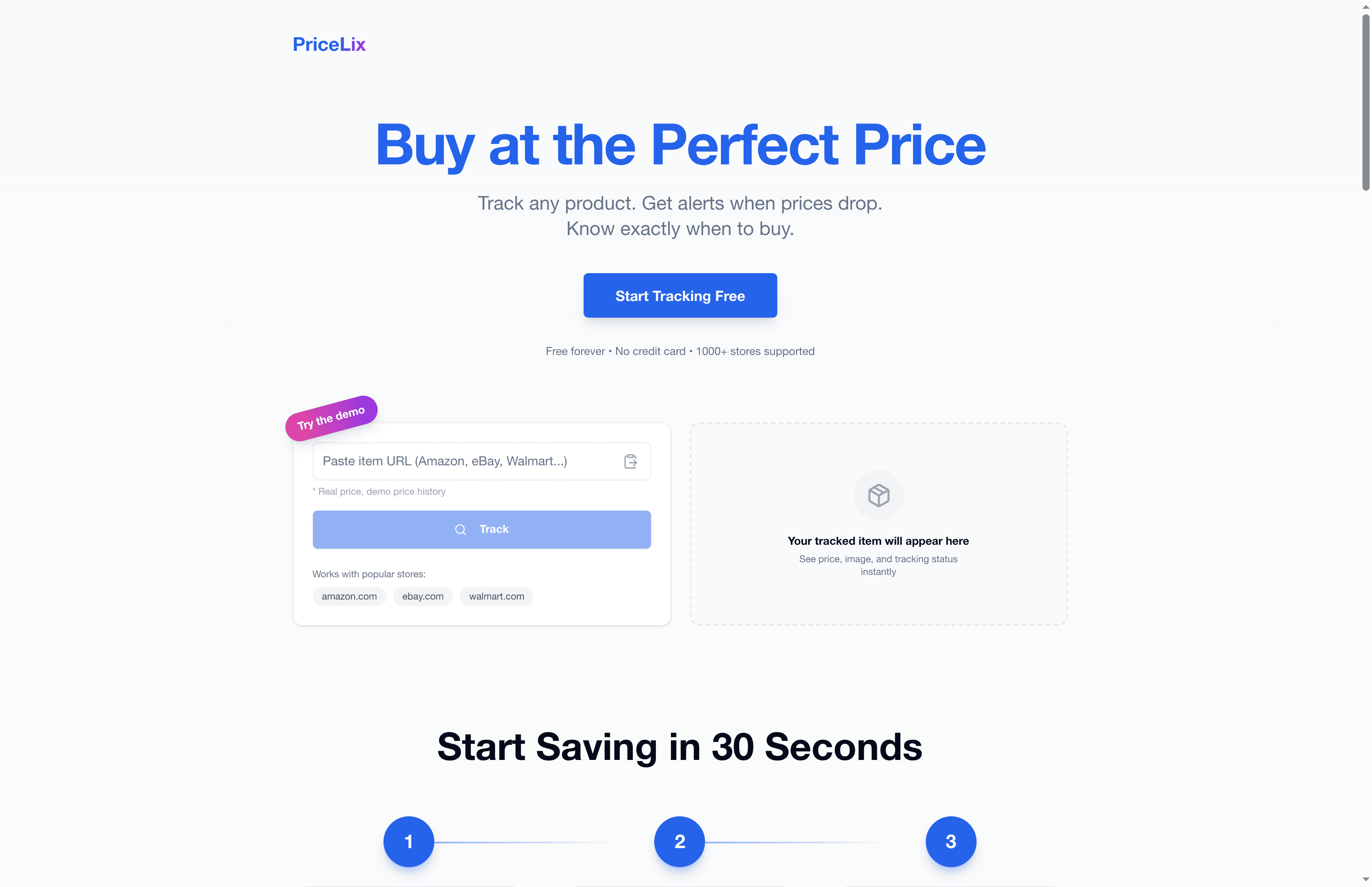
Ready to stop guessing and start saving with precision timing and real-time notifications? Experience a hassle-free way to track prices and capitalize on deals exactly when they happen. Visit PriceLix today to join savvy shoppers using smart strategies straight from the 6 Best Price Tracking Strategies 2026 for Online Shoppers article. Make informed decisions, avoid overpaying, and turn price tracking into consistent savings now.
Frequently Asked Questions
How do I set up automated price alerts for my favorite items?
You can set up automated price alerts by selecting the product you want to track, setting your target price, and choosing how often you want to be notified. Follow the specific steps on your preferred platform, and you can start saving money without constant manual checks.
What are price history charts, and how can they help me?
Price history charts visualize how an item’s price has changed over time, helping you identify trends and predict when discounts will occur. By studying these patterns, you can buy at optimal times instead of making impulsive decisions.
How can I track prices across multiple retailers at once?
To track prices across multiple retailers, use a price tracking tool that monitors several sites simultaneously. Focus on products with wider price ranges, as this strategy can help you find better deals without extra effort.
What should I avoid when tracking prices online?
Avoid pitfalls like trusting sponsored results, ignoring seller reputations, and missing hidden costs such as shipping fees. Instead, always verify prices from multiple sources and calculate the total cost before making a purchase decision.
How can timing tools enhance my savings during sales events?
Timing tools provide alerts for upcoming sales by analyzing historical data, ensuring you’re ready to purchase at the lowest prices. Set alerts for key sale events like Black Friday, and check prices regularly during those periods to maximize your savings.
How can I organize my desired products effectively using custom watchlists?
Create custom watchlists by grouping items into categories based on urgency, such as “Immediate” or “Later.” This organization helps you prioritize your purchases, ensuring that you stay focused on the items you need most without losing track of potential savings.