
What drives e-commerce pricing? Key strategies shoppers need
TL;DR:
- Online prices are driven by multiple strategies including dynamic, psychological, and value-based pricing.
- Dynamic pricing algorithms adjust prices frequently based on demand, competition, and browsing behavior.
- Savvy shoppers can save by tracking prices, setting alerts, and understanding pricing tactics.
You’ve seen it happen. You add a product to your cart, come back an hour later, and the price has jumped $15. Or you spot a deal that seems incredible, only to find it was higher last week. None of this is random. Online prices move constantly, driven by layered strategies that combine technology, economics, and human psychology. Once you understand what’s actually happening behind those price tags, you stop being a passive shopper and start making moves that actually save money.
Table of Contents
- The six core strategies that drive e-commerce pricing
- Dynamic pricing, algorithms, and how technology sets today’s prices
- How psychological pricing and value focus shape what you pay
- Economic forces, elasticity, and why prices keep changing
- Why understanding pricing drivers puts you ahead as a shopper
- Save more, shop smarter with PriceLix
- Frequently asked questions
Key Takeaways
| Point | Details |
|---|---|
| Core strategies | E-commerce pricing is driven by six core methods, each influencing shopper outcomes. |
| Dynamic pricing impact | Real-time algorithms increase sales but also raise the risk of shoppers paying more or abandoning carts. |
| Psychology matters | Charm pricing and value perceptions often lead shoppers to spend more without realizing it. |
| Economic factors | Category trends and inflation drive discounting and price hikes across the web. |
| Shoppers’ advantage | Understanding and tracking these drivers lets you shop smarter and score better deals. |
The six core strategies that drive e-commerce pricing
With the basics in mind, let’s break down what truly shapes online pricing day to day. Retailers don’t just pick a number and stick with it. They draw from a toolkit of strategies, each one designed to maximize revenue while keeping you clicking “buy.”
E-commerce pricing is primarily driven by six core approaches: cost-plus pricing, competitive pricing, value-based pricing, psychological pricing, bundle pricing, and dynamic pricing. Each plays a different role depending on the product, the platform, and the moment.
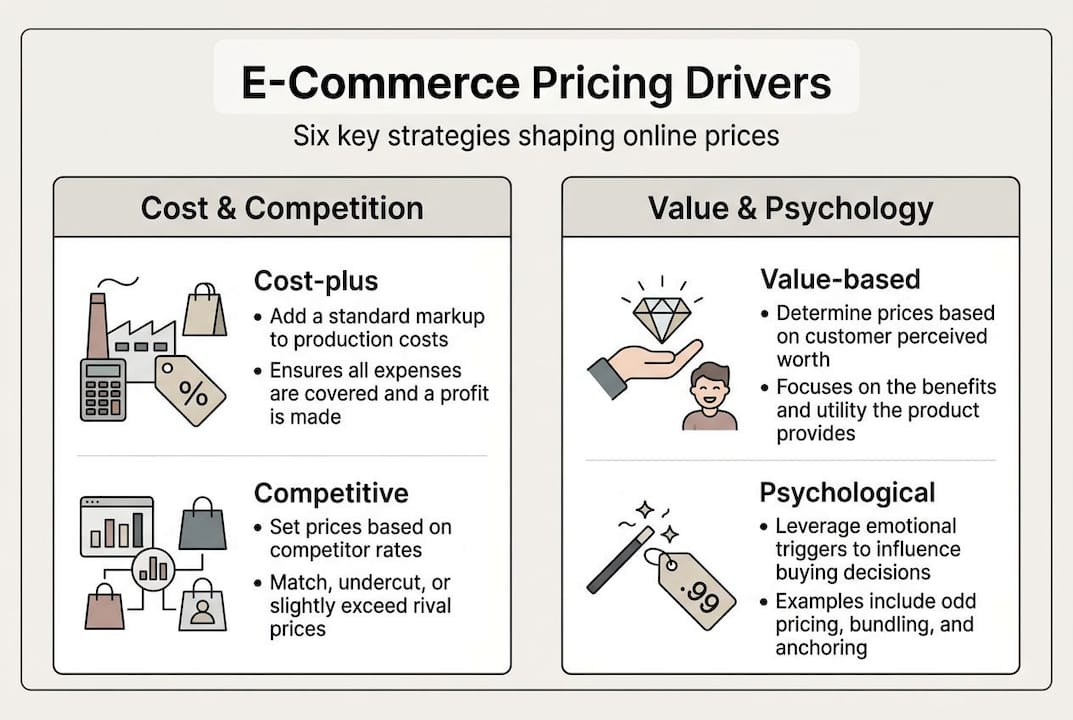
| Strategy | Core feature | When retailers use it |
|---|---|---|
| Cost-plus | Adds markup to production cost | Niche or private-label goods |
| Competitive | Matches or undercuts market prices | High-competition categories |
| Value-based | Priced on perceived customer value | Premium and brand-name products |
| Psychological | Uses charm prices like $9.99 | Impulse buys and promotions |
| Bundle pricing | Groups items for a perceived discount | Cross-selling and clearance |
| Dynamic pricing | Adjusts in real-time | Seasonal demand, peak traffic times |
Here’s why this matters to you as a shopper:
- Cost-plus items are rarely discounted heavily because margins are already tight.
- Competitive pricing means big drops are possible if a rival retailer moves first.
- Value-based pricing is sticky. Brands won’t cut price easily because it undercuts their image.
- Psychological pricing is everywhere and nearly invisible. You feel like you’re paying less.
- Bundle deals sometimes inflate individual prices first, so the bundle looks better than it is.
- Dynamic pricing is your biggest opportunity. Prices shift fast, and timing is everything.
Understanding the mix of factors affecting online prices helps you recognize patterns and predict when a better deal might be coming.
Pro Tip: If a product you want uses competitive pricing (think electronics or home goods), watch what competing retailers are doing. A price war between stores often means savings for you.
Dynamic pricing, algorithms, and how technology sets today’s prices
Among those core strategies, dynamic pricing powered by technology is changing the game fastest. Here’s how it works, and what you can do about it.
Dynamic pricing means a retailer’s system automatically adjusts prices based on live data. No human is sitting there updating prices manually. Algorithms do it instantly, sometimes hundreds of times per day.
AI and machine learning enable this by forecasting demand, analyzing competitor pricing, tracking your browsing behavior, and even factoring in the time of day. The system learns what works and keeps optimizing.
Here’s a simplified look at how a dynamic pricing algorithm reacts in real-time:
- Demand spikes. A product goes viral or a holiday begins. The algorithm detects increased search volume.
- Competitor prices rise. The system scans rival listings and sees they’ve increased their price.
- Inventory shrinks. Low stock signals urgency. The algorithm pushes the price up.
- Traffic slows. Late night or off-peak hours arrive. The price may dip slightly to capture any remaining buyers.
- You add to cart but don’t buy. Some systems register this signal and may adjust price or trigger a remarketing discount.
The impact is real. Dynamic pricing boosts seller revenue by 12.3%, but it also increases cart abandonment by 8.7%. Shoppers feel the instability and sometimes just walk away.
Here’s how the categories shake out:
| Category | Price change frequency | Shopper impact |
|---|---|---|
| Electronics | Multiple times daily | High abandonment risk |
| Travel/hotels | Hourly | Book early or off-peak |
| Fast fashion | Weekly to daily | Sales cycle is predictable |
| Groceries | Weekly | Inflation sensitive |
| Home goods | Bi-weekly | Seasonal patterns visible |
Understanding dynamic pricing explained in depth gives you the edge to time purchases and avoid peak pricing windows. You can also track real-time price changes to see exactly when prices move and act before they climb again.
How psychological pricing and value focus shape what you pay
Besides technology, human psychology is a powerful lever, often working without you realizing it. Here’s how.

Retailers have known for decades that perception beats reality in pricing. The number you see doesn’t just communicate cost. It shapes how you feel about the deal.
Here are the psychological triggers retailers use intentionally:
- Charm pricing: Setting a price at $9.99 instead of $10 makes the product feel significantly cheaper, even though the difference is one cent.
- Anchor pricing: Showing a “was $199, now $129” framing makes $129 feel like a steal, even if it was never really worth $199.
- Artificial urgency: “Only 3 left in stock” or “Sale ends in 2 hours” pushes you toward impulse decisions.
- Bundle illusions: Grouping three items at $49 feels like value, but each item alone might be $14.
- Decoy pricing: Adding a mid-tier option makes the higher-priced item look more reasonable by comparison.
Charm pricing drives a 3.2% bump in conversion rates. That’s a meaningful lift for retailers, and it comes entirely from perception, not value.
Value-based pricing adds another layer. When a brand prices a product based on what customers believe it’s worth, not what it costs to make, it creates a ceiling that rarely drops. Think Apple products or high-end skincare. These prices feel permanent because the brand has built an image that justifies them. Discounts here are rare, and when they appear, they move fast.
Pro Tip: Before buying anything over $50, wait 48 hours and check price history. Urgency messaging is almost always a tactic, not a real deadline. Use price optimization methods to get a clearer view of whether a deal is real or manufactured.
Economic forces, elasticity, and why prices keep changing
Beyond technology or psychology, the broader economic picture is the hidden motor driving why pricing shifts week to week.
Inflation, supply chain disruptions, and shifts in consumer demand all create ripple effects across e-commerce prices. When shipping costs spike or a supplier raises their rates, that cost moves downstream, often quietly and quickly.
Not all products react the same way to these forces. That’s where price elasticity comes in. Elasticity measures how much demand changes when a price changes.
“Price elasticity in U.S. e-commerce averages -1.34 overall, ranging from -1.72 in electronics to -0.89 in fashion.”
What does this mean practically? Electronics shoppers are very sensitive to price changes. Raise the price even a little and many buyers walk. Fashion shoppers are more forgiving. Retailers use this data to know exactly how much they can push prices before losing you.
Here’s how elasticity plays out by category:
- Electronics: Extremely elastic. Even small price hikes drive shoppers to competitors or waiting. Best time to buy is off-cycle, not at launch.
- Fashion: Less elastic. Brands can hold higher prices longer. Wait for end-of-season sales.
- Groceries: Inelastic for essentials, elastic for premium items. Stock up on staples when prices dip.
- Home goods: Moderately elastic, with strong seasonal patterns around holidays and back-to-school events.
The broader economic landscape shaped 2025 pricing heavily. Consumer goods firms achieved 8.4% net price growth in 2025 through list price increases and discount discipline, yet still missed revenue targets by 2.7%. A notable 45% of firms actually reduced discounts. That restraint is rolling into 2026, meaning the big blanket sales you might expect are less common. Shoppers need to be more strategic, not just patient.
If you’re tracking something like Samsung TV pricing trends, understanding elasticity tells you exactly when a deal window is likely to open. Pair that with broader online pricing tactics and you have a real edge.
Why understanding pricing drivers puts you ahead as a shopper
Here’s my honest take: most shopping advice is stuck in the coupons-and-cashback era. “Use a promo code.” “Wait for Black Friday.” That’s fine, but it misses the bigger picture entirely.
The reality is that most meaningful price drops are algorithmic and time-sensitive. They happen at 2 a.m. when demand dips. They happen when a competitor slashes their price and the algorithm responds within minutes. They’re not announced. They don’t wait for you.
This is where conventional wisdom fails shoppers. Waiting for a sale is passive. Tracking price history and setting alerts is active. The difference between those two approaches can be hundreds of dollars saved per year.
I’ve seen shoppers use bargain hunting strategies combined with price history tips to catch drops that lasted less than six hours. That’s not luck. That’s preparation.
Pro Tip: Set price drop alerts before you need to buy, not after you’ve already decided. Patience built into your process, not applied at the last second, is what separates good deals from great ones.
The bottom line is this: retailers have invested millions into pricing technology. The least you can do is spend five minutes setting up a tracker.
Save more, shop smarter with PriceLix
Ready to take control? Give yourself a pricing edge with the right tools and know-how.
Everything covered in this guide, from dynamic pricing windows to psychological tactics, becomes actionable when you have real data in front of you. That’s exactly what PriceLix is built for. It tracks prices automatically across Amazon, eBay, Walmart, and over a thousand other stores, sends you real-time alerts when prices drop, and gives you full price history charts so you can see what a product actually costs over time.
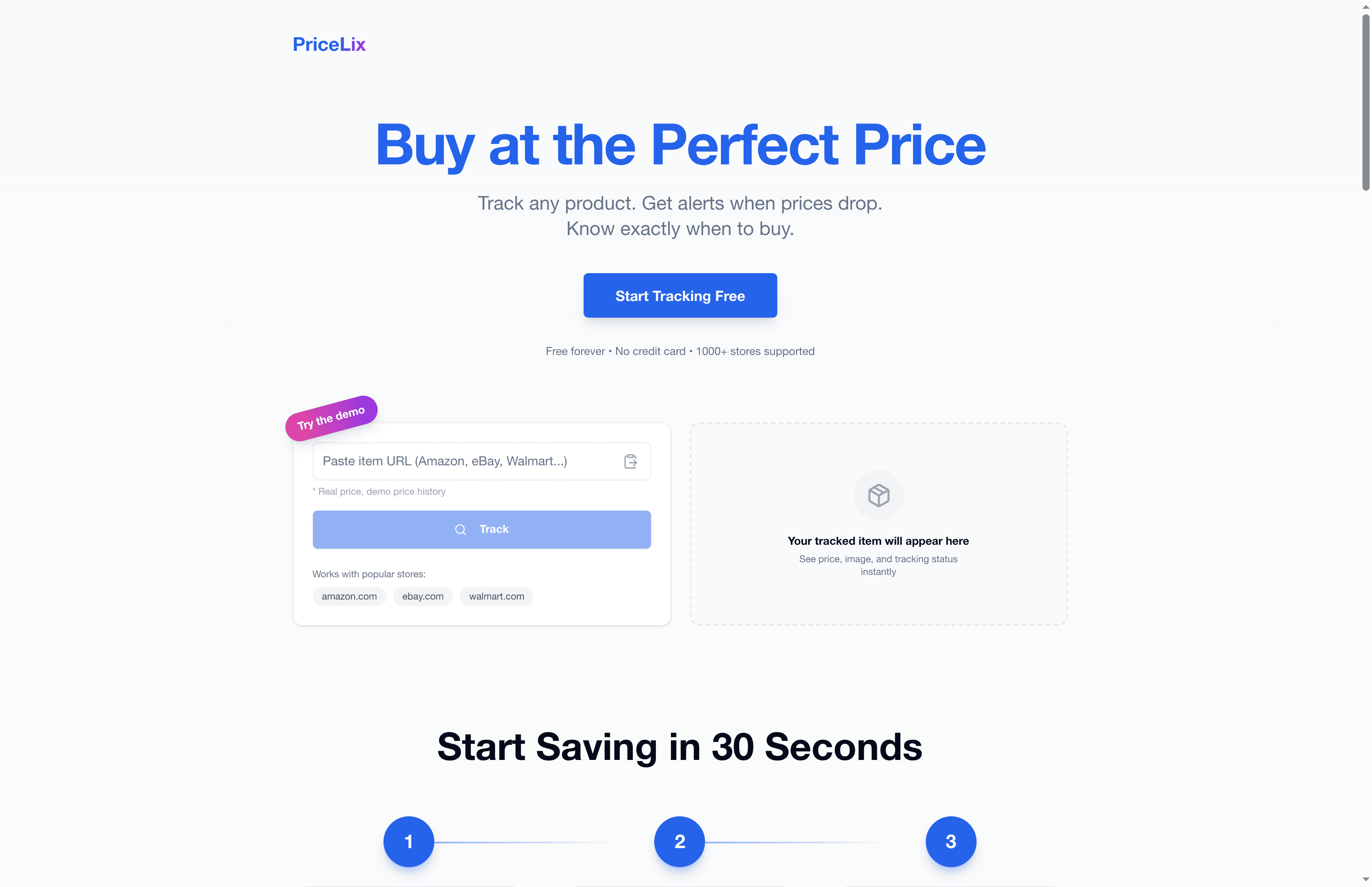
No browser extensions needed. No manual checking. Just clear data and smart alerts so you can stop guessing and start saving. Pair the strategies from this guide with bargain hunting tips from the PriceLix blog and you’ll have everything you need to shop with real confidence.
Frequently asked questions
Which e-commerce categories use dynamic pricing the most?
Electronics, travel, and fast-fashion retailers rely most heavily on dynamic pricing algorithms. Electronics price elasticity hits -1.72, meaning even small price shifts cause big changes in buyer behavior, which pushes retailers to adjust prices constantly.
How can I avoid overpaying due to psychological pricing tactics?
Delay big purchases by at least 48 hours, use a price tracker to verify real value, and stay alert to charm prices like $9.99. Charm pricing boosts conversions by 3.2%, so retailers lean on it hard.
What role do AI and algorithms play in price changes?
AI and machine learning enable real-time pricing adjustments based on demand, competition, and individual shopper behavior. AI-powered dynamic pricing uses demand forecasting and competitor analysis to update prices instantly, sometimes multiple times per hour.
Do discount rates change depending on the economy?
Yes, discounting tightens significantly when inflation or supply pressure hits. 45% of consumer firms reduced discounts in 2025 to offset revenue gaps, meaning the era of easy sale prices is becoming less reliable for shoppers counting on them.
Recommended
- Price optimization: save 15-40% on every online purchase | PriceLix
- Factors Affecting Online Prices: Save More in 2026 | PriceLix
- Understanding seller price changes: smart shopping insights | PriceLix
- Master online pricing tactics for smarter shopping | PriceLix
- Sneaker flipping: strategies, profits, and market realities – Flex Store