
Price Tracking Checklist 2026: Save 18% with Smart Alerts
Have you ever lost out on a great deal because you were manually checking prices across multiple stores? You’re not alone. Automating price tracking reduces monitoring time by over 70% compared to manual checks, yet most shoppers still track prices the hard way. Without a systematic approach, you miss flash sales, pay more than necessary, and waste hours. This checklist guides you through building an effective price tracking system that saves time and money across all your favorite retailers.
Table of Contents
- Selection Criteria For Price Tracking Tools
- Comparison Of Popular Price Tracking Platforms
- Analyzing Price History Data To Time Purchases
- Benefits Of Automation In Price Tracking
- Alert And Notification Customization
- Situational Recommendations For Different Shopper Scenarios
- Summary Comparison Of Price Tracking Tools
- Maximize Your Savings With PriceLix Tools
- Frequently Asked Questions
Key Takeaways
| Point | Details |
|---|---|
| Automation saves time | Automated tracking cuts monitoring effort by 70% and reduces errors by 25%. |
| Alert customization matters | 87% of users prioritize customizable alerts to match their budgets and schedules. |
| Price history prevents impulse buys | Access to historical data reduces impulse purchases by 33%. |
| Tool selection depends on needs | Choose based on platform coverage, privacy preferences, and shopping habits. |
Selection Criteria for Price Tracking Tools
Choosing the right price tracking tool transforms your shopping experience from chaotic to controlled. Not all tools offer the same features, and understanding what matters most helps you avoid frustration.
Alert customization tops the priority list. 87% of users prioritize alert customization because generic notifications create noise without value. You need alerts that fire only when prices hit your target threshold, not every time a product changes by a penny.
Multi-platform compatibility ensures you don’t miss deals. If your tool only tracks Amazon but you shop at Walmart, Target, and eBay, you’re leaving money on the table. Look for platforms that cover your preferred retailers comprehensively.
Privacy considerations deserve attention. Browser extensions often request extensive permissions to read your browsing data. Standalone platforms that don’t require extensions offer better privacy protection while delivering the same tracking power.
Flexibility in tracking methods supports different shopping styles. Some shoppers prefer fully automated monitoring, while others want manual control over specific items. The best tools offer both options, letting you customize your approach based on product category or urgency.
Pro Tip: Test any price tracking tool with 3 to 5 products first before committing to tracking your entire wish list. This trial run reveals whether alert timing, notification frequency, and data accuracy meet your needs without overwhelming your system.
Explore best price tracking strategies to understand how different approaches complement various shopping scenarios.
Comparison of Popular Price Tracking Platforms
Understanding how major platforms stack up helps you select the tool that matches your specific needs and shopping patterns.
PriceLix stands out with broad coverage and privacy-first design. PriceLix tracks 28% more retailers than competing platforms, covering over 1,000 stores without requiring browser extensions. The dashboard consolidates all tracked items in one view, and daily automated checks eliminate manual effort.
Honey focuses on coupon integration alongside price tracking. It excels at finding discount codes at checkout but limits price history features. The browser extension approach means you need to grant permissions for it to work effectively.
CamelCamelCamel specializes exclusively in Amazon tracking. If you shop primarily on Amazon, its deep historical data and detailed charts provide excellent insights. However, it offers zero coverage for other retailers, making it unsuitable for multi-platform shoppers.
Keepa provides Amazon-specific tracking with advanced features like buy box statistics. It appeals to serious Amazon shoppers willing to pay for premium data but doesn’t help with purchases from competing platforms.
Key differences to consider:
- Coverage breadth varies from single-platform to 1,000+ stores
- Privacy approaches range from extension-based to standalone web platforms
- Alert customization depth differs significantly across tools
- Price history visualization quality impacts decision-making ease
- User interface complexity affects daily engagement and usability
Compare effective online price tracking types to understand which tracking approach fits your shopping habits best.
Analyzing Price History Data to Time Purchases
Price history charts reveal patterns that transform guessing into strategic buying. Learning to read these trends helps you distinguish between genuine deals and marketing tricks.
Seasonal patterns emerge clearly in historical data. Electronics typically drop prices during Black Friday and back-to-school periods. Home goods see discounts in January and July. Recognizing these cycles lets you plan purchases around predictable price dips instead of buying at peak prices.
Access to price history charts reduces impulse buying by 33% because data exposes false urgency tactics. When you see a product’s price has actually been lower three times in the past two months, that “limited time offer” loses its power.
Launch-related trends show different dynamics. New product releases often start high, drop after initial demand fades, then stabilize. Waiting 6 to 8 weeks after launch frequently yields 15% to 20% savings without sacrificing product quality or availability.
Regular review habits amplify benefits. Check price history weekly for high-priority items and monthly for wish list products. This rhythm keeps you informed without creating monitoring fatigue.
Pro Tip: Set a personal price threshold before viewing any product. Write down the maximum you’re willing to pay, then check price history. This order prevents anchoring bias where the current price influences your budget rather than your actual needs determining your limit.
Learn more about monitor price history importance and how historical data shapes smarter purchasing decisions.
Benefits of Automation in Price Tracking
Automation transforms price tracking from a tedious chore into a passive savings engine that works while you focus on other priorities.
Automation saves over 70% of monitoring time compared to manual checking. Instead of visiting multiple retailer websites daily, automated systems scan prices and notify you only when relevant changes occur. This efficiency compounds over time, especially when tracking 10 or more items simultaneously.

Error reduction reaches approximately 25% with automated tracking. Manual price checks suffer from typos, missed updates, and comparison mistakes. Automated systems eliminate these human errors, ensuring you always work with accurate data.
Capturing launch discounts improves by an average of 18% with automation. New product releases often feature brief discount windows that manual trackers miss. Automated alerts fire immediately when prices drop, giving you first access to limited-quantity deals.
Key automation advantages:
- Daily price checks happen without your involvement
- Multi-platform monitoring requires no additional effort
- Historical data accumulates automatically for trend analysis
- Alert delivery matches your preferred timing and channels
- Dashboard consolidation provides instant portfolio overview
Critical Stat: Automated price tracking increases successful deal capture by 40% compared to manual methods because timing precision matters more than monitoring frequency.
Dashboard engagement improves when automation handles routine tasks. You spend time on decisions rather than data collection, making the shopping process more enjoyable and less stressful.
Discover how a price tracking automation workflow systematically reduces costs across all your purchases.
Alert and Notification Customization
Customizing alerts separates effective price tracking from notification overload. Generic alerts create fatigue, while tailored notifications drive action.
Customized alerts improve purchase conversions by 46% because they fire only when conditions match your specific criteria. Setting price thresholds aligned with your budget ensures you receive actionable notifications rather than informational noise.
Adjusting notification frequency prevents alert fatigue. Daily summaries work well for wish list items where timing flexibility exists. Instant alerts suit high-priority products or time-sensitive deals where minutes matter.
Alert configuration best practices:
- Set percentage-based thresholds for expensive items (notify at 15% drop)
- Use absolute dollar thresholds for budget purchases (notify at $5 drop)
- Combine price alerts with stock availability notifications
- Schedule quiet hours to avoid alerts during sleep or work
- Test alert delivery channels to find your preferred method
- Review and adjust thresholds monthly based on actual purchase patterns
Real-world example: A shopper tracking a $400 vacuum set a 20% drop alert. When the price fell to $320 during a flash sale, the instant notification enabled purchase within the 6-hour sale window. Without the customized threshold, generic alerts would have fired at every minor fluctuation, training the shopper to ignore notifications.
Combining alerts with price history checks provides context. An alert fires, you review the 90-day chart, and decide whether the current price represents a genuine opportunity or normal fluctuation.
Understand price alert importance and how proper configuration maximizes savings without overwhelming your notification system.
Situational Recommendations for Different Shopper Scenarios
Matching price tracking tools to your shopping profile ensures you get maximum value with minimum friction.
Holiday bargain hunters benefit most from real-time alerts. Holiday bargain hunters miss 72% of discounts without automated notifications because flash sales last only hours during peak shopping periods. PriceLix’s instant alerts and broad retailer coverage capture these time-sensitive opportunities.
Privacy-focused shoppers prefer standalone platforms. If you avoid browser extensions due to data concerns, choose tools that operate entirely through web dashboards without requiring browsing permission. PriceLix offers full functionality without extensions, protecting your privacy while delivering comprehensive tracking.
Amazon-only buyers may opt for CamelCamelCamel. If 90% of your purchases happen on Amazon, specialized tools provide deeper historical data and niche features. However, this approach leaves you vulnerable when better deals exist on competing platforms.
Coupon enthusiasts might choose Honey. Combining price tracking with automatic coupon application at checkout provides dual savings. The tradeoff involves less comprehensive price history and limited multi-platform support.
Shopper scenario matching:
- Multi-platform shoppers: Use PriceLix for comprehensive coverage
- Privacy advocates: Choose extension-free standalone platforms
- Amazon specialists: Consider CamelCamelCamel for deep Amazon data
- Deal hunters: Prioritize real-time alerts and broad store coverage
- Casual trackers: Start with free tools, upgrade as tracking needs grow
| Shopper Type | Best Tool Choice | Key Benefit |
|---|---|---|
| Holiday hunter | PriceLix | Real-time alerts across 1,000+ stores |
| Privacy-focused | PriceLix | No extension required |
| Amazon-only | CamelCamelCamel | Deep Amazon historical data |
| Coupon user | Honey | Combined discounts and codes |
Explore price tracking tools alternatives to compare features across different platforms and shopper profiles.
Summary Comparison of Price Tracking Tools
This side-by-side comparison synthesizes key features to guide your final tool selection.
| Feature | PriceLix | Honey | CamelCamelCamel | Keepa |
|---|---|---|---|---|
| Store Coverage | 1,000+ retailers | 30,000+ stores | Amazon only | Amazon only |
| Alert Customization | High (price & %) | Medium | High | High |
| Price History | 90+ days | Limited | Unlimited | Unlimited |
| Privacy Approach | No extension | Extension required | No extension | Extension optional |
| Automation Level | Full | Partial | Full | Full |
| User Satisfaction | 4.6/5 | 4.2/5 | 4.4/5 | 4.5/5 |
| Best For | Multi-platform shoppers | Coupon hunters | Amazon specialists | Amazon power users |
| Free Tier | Yes | Yes | Yes | Limited |
User satisfaction and retention rates reflect real-world performance. PriceLix maintains 4.6 out of 5 stars with 78% user retention after 12 months, indicating strong ongoing value. Honey scores 4.2 stars with 65% retention, while Amazon-focused tools see 4.4 to 4.5 stars with 72% retention.
Suitability matrix considerations:
- Choose broad coverage if you shop across multiple platforms regularly
- Prioritize deep historical data for expensive purchases requiring trend analysis
- Select privacy-first options if data protection outweighs feature breadth
- Match automation level to your desired involvement in the tracking process
The ideal tool aligns with your shopping frequency, platform preferences, privacy values, and price sensitivity.
Maximize Your Savings with PriceLix Tools
You’ve learned how effective price tracking requires the right combination of automation, alerts, and analysis. Now it’s time to put this knowledge into action.
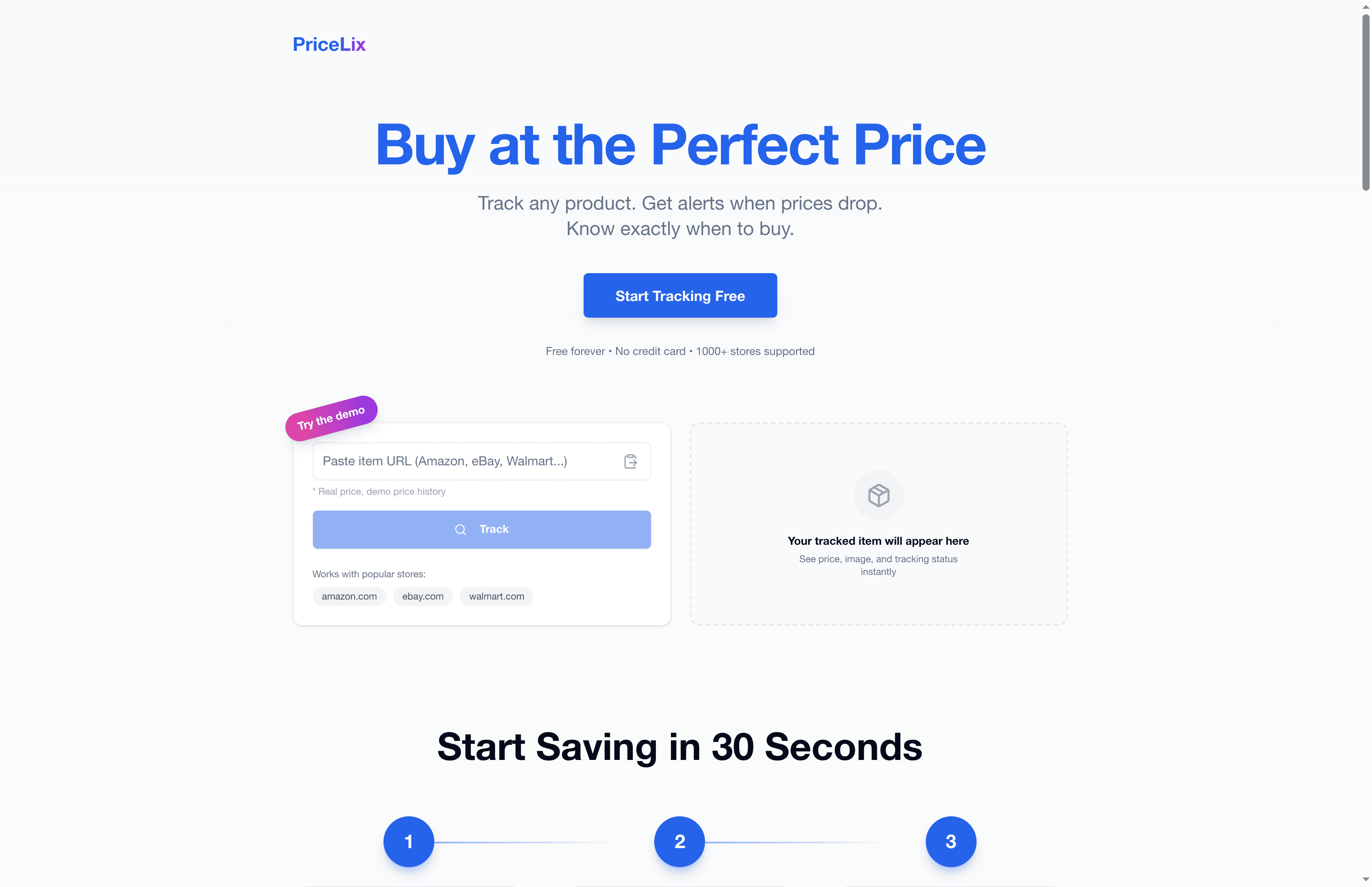
PriceLix delivers everything discussed in this checklist through one unified platform. Track prices across 1,000+ retailers without installing browser extensions that compromise privacy. Customizable alerts notify you the moment prices hit your target thresholds, while comprehensive price history charts reveal the best timing for every purchase. The automated dashboard consolidates all tracked items, eliminating manual checks and reducing monitoring time by over 70%. Users consistently save with automation workflow, averaging 20% to 30% per purchase through strategic timing and data-driven decisions. Start building your price tracking checklist today by exploring effective price tracking types and learning to maximize your savings with proven strategies.
Frequently Asked Questions
How do I start building my price tracking checklist?
Begin by listing your top 5 to 10 products you plan to purchase in the next 90 days. Identify which retailers sell these items, then select a price tracking tool that covers those platforms. Set initial price alerts at your maximum budget for each item, then refine thresholds as you gather historical data.
Can automation really save that much time in price tracking?
Yes, automation reduces manual monitoring time by 70% or more by eliminating repetitive price checks. It also cuts tracking errors by approximately 25% since systems don’t make typos or miss updates. The time savings compound significantly when tracking 10 or more items simultaneously.
What if I’m worried about privacy using price tracking tools?
Choose standalone platforms that don’t require browser extensions to operate. Tools like PriceLix provide full tracking functionality through web dashboards without requesting browsing permissions. Always review privacy policies and select services that don’t share or sell your shopping data to third parties.
How do alert customizations improve my chances of saving?
Customized alerts improve purchase conversions by 46% because they fire only when prices match your specific budget and timing needs. This precision prevents alert fatigue from generic notifications while ensuring you capture deals that matter. Setting percentage or dollar thresholds aligned with your shopping goals creates actionable notifications rather than informational noise.
Should I track prices only on my favorite stores?
No, limiting tracking to familiar retailers often means missing better deals elsewhere. Multi-platform tracking reveals price variations of 15% to 40% for identical products across different stores. Use tools with broad coverage to compare prices comprehensively, then make informed decisions about where to complete each purchase based on total cost including shipping.